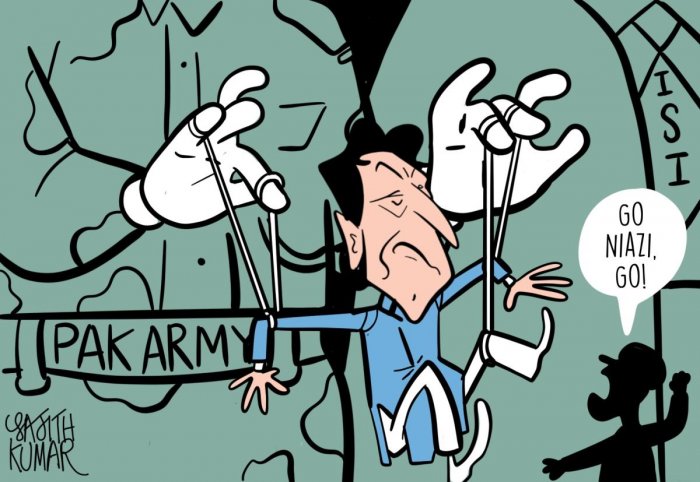
For the first time, the Pakistan Army has come under attack from an Opposition political coalition? (Originally published on 8 November 2020 by Deccan Herald)
Vote ko izzat do!’ ‘Go Niazi, Go Niazi’! It’s a shrill war cry that has resonated across Pakistan since September after the newly formed eleven party opposition alliance, the Pakistan Democratic Movement brought city after city to a halt, with one mega rally after another.
Behind the theatrics and the biting rhetoric is an extraordinarily bold, albeit naive attempt to whip up street power to dislodge the big bullies. But will it go far enough? Certainly, this is the first time in over 70 years that any Opposition party, let alone eleven of them, have openly called out the unholy trinity – the Pakistan Army, its counter-intelligence wing the Inter Services Intelligence and their alleged ‘pick’ for prime minister, Imran Khan Niazi – for who and what they are.
This is a seminal moment in Pakistan’s history. This is Pakistan Muslim League’s ailing leader Nawaz Sharif’s last ditch attempt to transform the very nature of the Pakistani state and reclaim civilian legitimacy. And in working alongside Pakistan People’s Party’s Bilawal Bhutto Zardari and old school politician and powerful cleric, Maulana Fazlur Rehman of the Jamiat-Ulema-e-Islam (Fazl), and powerful Baloch and Pashtun leaders, putting an end to old rivalries that only played into the army’s hands, they have deprived the Army-ISI cabal of one of its key stratagems of playing one party or faction against another.
But the politics of intimidation by ‘the boys’ – one of many monikers for the ISI – remains as much in play today as in years past, as was more than amply demonstrated by the ISI’s antics on the night of October 18. Soon after the foes turned friends concluded their mammoth rally in Karachi, which part commemorated the failed 2007 assassination bid against former premier Benazir Bhutto, the League’s fiery new face Maryam Nawaz and her husband Capt (retd) Safdar Awan were settling in for the night at a Karachi hotel when the paramilitary Pakistan Rangers broke down the door to their hotel room and dragged Safdar off to jail.
If it was an attempt to frighten Maryam into submission, or divide the opposition as Sindh is ruled by the PPP, it didn’t work. In fact, with the army chief Gen. Qamar Javed Bajwa reaching out directly to Bilawal as well as the police chief , who was taken to police headquarters to sign Safdar’s detention orders at midnight at the ISI’s behest, there is speculation the generals may not all be on the same page. It remains to be seen if all that Gen. Bajwa was attempting to do, was douse the fires in the face of growing outrage at the ISI’s meddling.
But, for me, watching the arrest unfold was a chilling reminder of how, exactly thirteen years ago to the day, slap bang in the ISI’s cross-hairs, I came very close to meeting a similar fate. And how little Pakistan had changed…
On the night of October 18, 2007, hours after the failed assassination attempt on Benazir when she landed in Karachi, a whole complement of her circle of journalist friends and close advisers sat with the feisty leader through the night at her home in the tony suburb of Clifton. As one of the journalists who had been invited to travel back with the former Pakistan prime minister as she ended eight years of exile in the United Arab Emirates, we crowded into her living room, shaken by the twin suicide bomb attacks, unleashed minutes before midnight as her 100 car convoy snaked its way through the port city. One of the bombs, we would later learn, was strapped to a man, holding aloft a crying baby.
The crowded street where the suicide bombers had detonated themselves was covered with body parts, the screams of the dying and injured PPP workers who paid the price for throwing a protective ring around their leader’s armoured truck, was playing out on television screens; And for those of us who walked on that blood-soaked street, it played out repeatedly, in our minds.
The Karachi assassination came a cropper, but two months later on December 27, another clutch of suicide bombers in Rawalpindi would tragically, claim their grisly prize.
But that night in President Gen. Pervez Musharraf’s Pakistan, where ‘the deep state’ had pulled out all the stops to silence a political foe who refused to be cowed, it didn’t stop with the attack on big fish Benazir or the PPP ‘jiyalas’, her army of loyalists. We, the minnows faced the blowback as the ISI’s vast network of operatives, went into top gear.
As I checked into a Karachi hotel in the early hours, I faced the kind of intimidation and harassment that is par for the course in Pakistan, detailed to perfection in a provocative new book “The Nine Lives of Pakistan’ by the former Guardian and New York Times correspondent Declan Walsh, who was shunted out of the country in 2013 for crossing an unexplained red line. He was lucky. Daniel Pearl, Saleem Shahzad and countless other journalists and young politicians who speak for the rising anger among the Pashtuns, Balochis, Sindhis and Mohajirs – and increasingly, the Punjab in today’s Pakistan – were not.
That night in Karachi, I thought I had shaken off my tail. I had challenged a guy for taking pictures of me as I exited the airport. He said he’d lose his job if he didn’t. But I spotted him again, hanging around 70 Clifton, watching my every move and then solicitously, escorting me to my car when I was leaving. I thought I had nothing to worry about. I was wrong.
When someone began banging on the door to my hotel room at 4 am, I knew better than to open it. Journalist Carlotta Gall, had been famously attacked in her hotel room in the Balochistan capital, Quetta a year earlier. I quietly alerted the hotel’s general manager, whom I had known from before. He said he would convince them that I was not in the room. After the goons left, and at some risk to his own safety, he quietly shepherded me to another room without listing me as its occupant. But there was no let up. A Pakistani friend said they would stop following me after I made the mandatory reporting at the local police station. They didn’t.
Over the next few days as I navigated Karachi’s bustling streets, and in February the next year, when I traveled back to Pakistan to cover elections for a television channel, I was tailed, my car routinely blocked, the driver pressured to tell them where I was going. Some of the drivers, like many who befriend you in the real Pakistan and quietly push back against the intrusive ISI, reveled in giving them the wrong information.
The PPP won the 2008 election. It was a landslide. But just as it was under the preceding Nawaz Sharif governments that were prematurely dismissed, democracy and freedom under an elected government was no more than a fable, a myth. It didn’t stop the hide and seek with spooks who shadowed your every move, sidled up to you in hotel corridors to strike up conversations to find out what your plans were, listened in on your phone calls on the landline, and lurked in street corners and watched, knowingly, as you entered and exited the homes of politicians. I had become more cautious, avoiding hotels, staying at the homes of friends in Lahore and Islamabad so that there would be no more midnight knocks on the door.
Walsh’s book, in fact, eloquently reinforces the dichotomy within Pakistani society where the educated elite looked the other way but often railed against the ‘deep state’ in private. In Walsh’s case, as with many who covered Pakistan, his “countless stories on sensitive subjects like American drone strikes, nuclear weapons and the inner workings of the ISI…” were kosher, but it wasn’t until his numerous trips to Quetta, his stories on Taliban sanctuaries and army-led human rights abuses, that he received the ISI pink slip.
Today, there’s a ‘Naya Pakistan’ that is no longer in a two step with the army led dispensation of Imran Khan, consumed with delusions of grandeur, of being a part of a Turkey-Malaysia led mythic Valhalla, backed by China against arch enemy India. Despite the stringent controls and a largely captive media, a brave new generation that will not be cowed into silence is airing its anger in a series of potent podcasts. Anger against the blatant misuse of power and privilege by the ‘khakis’; specifically, the serving army chief Gen. Bajwa, the former ISI chief Gen. Zaheer ul Islam, the present ISI chief Gen. Faiz Hameed and the former officer in charge of the China Pakistan Economic Corridor, and Imran’s former adviser, Gen Asim Bajwa. Anger, that Imran, who some say has grown closer to the ISI chief, is blind to, as he is to his allies’ unhappiness with his style of leadership and refusal to pay heed to the threat posed by the PDM.
Whether the PDM gathers the momentum that is needed to force the present Imran Khan government from office or not, the public rallies in the army’s backyard of Gujranwala in the Punjab, the PPP stronghold of Karachi and surprisingly, Quetta, where Sardar Akhtar Mengal of the Balochistan National Party pulled in a mammoth crowd, and plans to do the same in restive Peshawar on November 22 and in League bastion, Lahore, cannot be glossed over. A restive Balochistan is now joined in its quest for greater freedoms by Pashtuns in Imran’s native province of Khyber Pakhtunkwa.
As Walsh writes, it’s not just the Baloch but the Pashtuns who are reclaiming their identity. He quotes a former ISI operative who tells him how in Afghanistan when fighting the Taliban, the Pashtuns were lionized as heroes, but when they demanded their rights at home, “Pashtuns were caricatured as terrorists, demonized.” The unrest in KP, just as Pakistan is poised to step into the vacuum left by U.S. forces as they exit Afghanistan, couldn’t come at a more inopportune moment for the army.
The army-ISI’s continuing “disproportionate sensitivity” over Balochistan and the “irredeemable interests in the parts of Pakistan the ISI wanted to hide,” as Walsh terms it, was in part, the reason that he – and I – were marked out for special treatment. Not only had I interviewed Nawaz Sharif, post his release from jail in early 2007 when he made no bones about wanting to settle scores with his nemesis President Musharraf, as did Benazir Bhutto before she returned home from exile, it was an interview with Baloch leader, Sana Baloch, that made the Army and ISI, turn apoplectic. It sees any interaction with Baloch leaders as a ploy to foment secession, while giving the Sharifs and the Bhuttos, a voice, was simply a no-no.
The irony is that these very men, who forced Pervez Musharaf into demitting office, and shunted him – one of their own – into exile after a judges protest could not be contained, are faced with another failed experiment in political engineering. In the past, the military-intelligence complex backed four military coups, where the army strongman blithely replaced both civilian protégés and lawfully elected civilians when they rejected their diktat on key issues such as making peace with India, or paying heed to Washington. This time, they thought they had played safe by installing a popular face as prime minister in the pliant Imran Khan who ceded all control on foreign policy to the deep state, only to find that his shelf life too could be as ephemeral as the generals’ who seized power.
Once again, the ‘chronic weakness’ of the Pakistan state recurs, as it plays out the last of its ‘nine lives’.
Copyright © 2020 Neena Gopal
 Neena Gopal